IR Lasers and IR Illuminators: The Difference Most Buyers Miss
Both are invisible to the naked eye. Both are used with night vision. Both show up in product listings for NV-compatible accessories. And both get referred to casually as "IR" — which is where the confusion starts. IR lasers and IR illuminators do fundamentally different things, and understanding the distinction is essential before buying either one.
The core distinction
An IR laser is an aiming device. It projects a tight, coherent beam of infrared light that appears as a point of light through night vision — your aiming dot, invisible to anyone not running NV. You put the dot on the target and shoot, the same way you'd use a visible laser in daylight. The beam is narrow, highly directional, and not designed to illuminate a scene.
An IR illuminator is a lighting device. It floods an area with infrared light — invisible to the naked eye, but visible through night vision — in order to improve what the NV device can see. Think of it as a flashlight that only NV can detect. It doesn't help you aim. It helps your NV system show you the scene.
Same invisible spectrum, completely different purposes. One puts a dot on a target. The other lights up the environment so your NV can function in it.
Neither works with thermal — NV only
This is the clarification that trips up a lot of buyers coming from the thermal side of the night optics market: IR lasers and IR illuminators are exclusively night vision tools.
Thermal imaging detects heat radiation — a completely different part of the electromagnetic spectrum from the near-infrared light that IR lasers and illuminators produce. A thermal scope cannot see an IR laser dot. A thermal imager does not benefit from an IR illuminator. If you're running thermal only, neither of these accessories applies to your setup.
IR lasers and IR illuminators are paired with image intensifier night vision devices — tube-based Gen 1, Gen 2, Gen 2+, and Gen 3 systems, or digital NV devices. The NV device amplifies the near-infrared light just as it amplifies ambient visible light, making the IR laser dot and the IR illuminated scene visible to the user.
IR illuminators: what they do and when you need one
Image intensifier tubes amplify available light — but they need some light to work with. In near-total darkness, tube-based NV performance degrades. The tube is amplifying noise as much as signal, and the image becomes grainy and difficult to interpret. An IR illuminator solves this by adding light to the scene — light only the NV device can see.
Most NV devices include a built-in IR illuminator for exactly this reason, but built-in illuminators are typically low-powered with limited range and coverage. Dedicated external IR illuminators extend that capability significantly — more output, greater range, adjustable beam width, and in some cases, switchable wavelengths.
Beam width matters operationally. A narrow IR illuminator throws light further but covers a smaller area — useful for identifying a specific target at distance. A wide flood beam covers more area with less range — useful for scanning or close-range awareness. Many quality illuminators offer adjustable beam width to serve both needs.
Wavelength matters for certain applications. The most common civilian IR illuminators operate at 850nm, which produces a faint visible glow — a dim red dot visible to the naked eye at close range. For hunting applications where spooking game is a concern, 940nm illuminators are truly invisible but sacrifice some output and range. We cover the wavelength tradeoff in more depth in our digital vs. analog night vision article.
Range and output vary significantly by unit. A low-powered built-in illuminator might be useful to 50–75 yards. A dedicated external illuminator with quality optics can extend useful NV range to 200+ yards in appropriate conditions. If your NV use involves scanning open terrain or engaging targets at distance, a quality external illuminator is often the missing piece in the system.
IR lasers: what they do and when you need one
An IR laser is a targeting tool — the NV-compatible equivalent of a visible laser sight. Through night vision, the IR dot appears clearly on the target. You can aim accurately without using iron sights or a magnified optic, which has significant practical advantages in low-light conditions where sighting systems that require eye alignment are slow and difficult to use.
The IR laser allows both-eyes-open target acquisition with NV — a natural, fast aiming method that works well in dynamic situations. This is why IR lasers are standard on military NV weapon setups, and why serious civilian NV shooters running hog eradication, predator control, or home defense setups adopt them.
IR lasers are NV-specific. Without a night vision device, you cannot see the dot. An IR laser has no use as a standalone visible-light aiming device — if that's what you need, a visible laser is the correct tool.
IR lasers require eye protection when in use. Even civilian-legal IR lasers project enough energy to cause eye damage on direct beam exposure. Appropriate laser eye protection for the wavelength in use should be worn whenever an IR laser is active. This is not theoretical caution — it is a real hazard.
The civilian legal landscape for IR lasers
This is worth understanding clearly before purchasing. IR lasers are regulated by the FDA under a framework that applies different rules to IR wavelengths than to visible lasers.
For visible lasers, civilian products can be sold up to the Class IIIa limit of 5mW. For IR wavelengths, the FDA requires civilian products to meet the more restrictive Class I limits — there are no intermediate civilian tiers for wavelengths outside the visible spectrum. High-powered IR aiming lasers — the kind used by military and law enforcement — are Class IIIb devices restricted to those markets.
In practical terms: civilian-legal IR laser products sold by reputable manufacturers are power-limited accordingly and legal to own and use. High-powered IR lasers marketed or obtained outside legal channels are a different matter entirely. When evaluating IR laser products, buying from established manufacturers who comply with FDA requirements is both a legal and a safety imperative. The power limits on civilian units are real — a military-spec IR laser operating at high-power mode is not a civilian-legal product in the United States.
Reputable civilian IR laser manufacturers design within these limits and produce products that are effective for their intended use cases within the legal framework.
Combo units: IR laser and illuminator in one
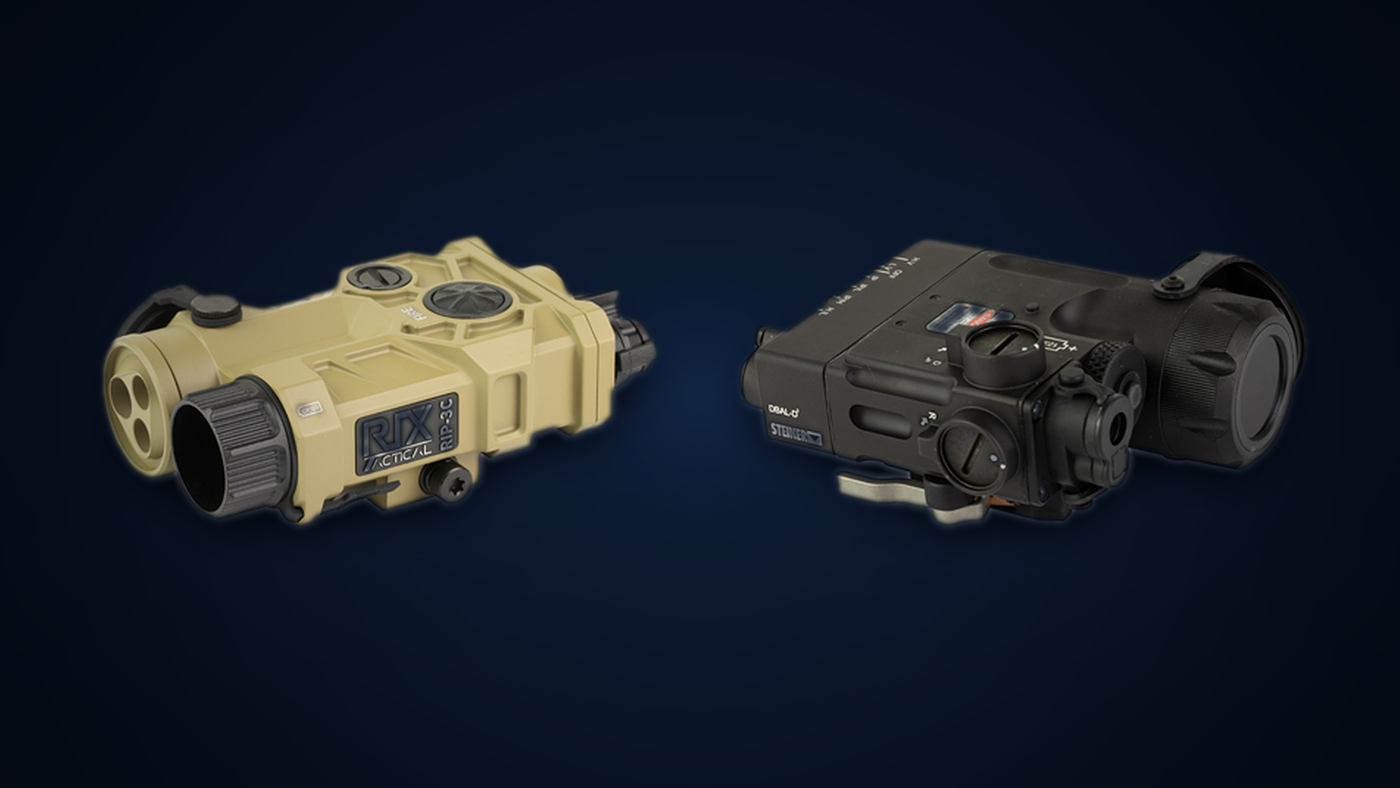
Many purpose-built NV weapon accessories combine an IR aiming laser and an IR illuminator in a single housing. This makes practical sense — both belong on the same platform for the same use case, and a single unit simplifies mounting, wiring, and activation.
Combination units typically offer separate activation controls for the laser and illuminator, allowing you to run either or both independently depending on the situation. Running the illuminator alone for scanning without the laser active is a common workflow — illuminate the scene to find the target, then activate the laser for the shot.
When evaluating combination units, look at the illuminator and laser specifications independently. A strong illuminator with a weak laser, or vice versa, is a real product category — the combo designation doesn't guarantee both functions are equally capable.
Practical uses by application
Hog and predator hunting at night: The combination of a quality IR illuminator and IR laser on a rifle is the standard effective setup for this application. The illuminator extends your NV's useful range into the scene; the IR laser provides fast, accurate target acquisition for the shot. Given that hog hunting often involves multiple animals moving quickly at varying distances, this combination allows fast engagement without the alignment demands of iron sights or a scope under NV.
Home defense with NV: An IR laser on a home defense carbine or shotgun allows natural, fast aiming without requiring a precise sight picture in a high-stress, low-light situation. The both-eyes-open aiming method with an IR laser through NV is more intuitive under stress than traditional sighting methods. An illuminator ensures the NV has adequate light to show you the scene even in total interior darkness.
Security and perimeter monitoring: IR illuminators placed as fixed or adjustable flood sources extend the range and coverage of NV monitoring systems significantly. An illuminator covering a gate, driveway, or field edge allows NV observation well beyond what ambient light or a built-in illuminator would support.
Range and training with NV: IR lasers are increasingly used in formal NV training courses. The ability to track the laser dot through NV provides immediate feedback on aiming stability and technique under conditions that would otherwise offer none.
What to look for when buying
For IR illuminators:
- Output power and rated range for your intended use distance
- Beam adjustment range — fixed flood vs. adjustable narrow/wide
- Wavelength — 850nm for most uses, 940nm if animal reaction to the faint visible glow is a concern
- Mount compatibility with your NV device or weapon platform
- Battery type and runtime
For IR lasers:
- FDA-compliant civilian power rating from a reputable manufacturer — not a negotiable point
- Wavelength — 850nm is standard and compatible with most NV devices
- Activation method — pressure pad, momentary switch, constant-on — and whether it matches your intended use
- Adjustment range for windage and elevation zeroing
- Durability and weather resistance
For combination units:
- Evaluate the illuminator and laser specs independently, not just the combined product description
- Confirm activation controls allow independent operation of each function
- Mounting footprint and compatibility with your platform
IR lasers and illuminators are accessories that extend what a night vision system can do — and choosing the right ones for your specific setup and use case is worth getting right. HildiTech carries NV-compatible IR accessories selected for the civilian hunter and shooter market.