The Shooter's Edge: How Technology Is Reshaping the Way We Train, Compete, and Operate
There's a version of this article that reads like a gear catalog — a breathless tour through the latest optics, electronics, and gadgets with the implicit message that buying enough of them will make you lethal. This isn't that article.
Technology in shooting is genuinely worth discussing seriously, because the honest story is more interesting than the marketing version. The tools have gotten dramatically better. Their potential to accelerate skill development is real. And the risks of misusing them — of substituting gear for capability — are just as real. Understanding the difference between those two outcomes is probably the most important thing a modern shooter can internalize.
How We Got Here
For most of the history of firearms, the technology was the gun. Improvements happened in metallurgy, in propellant chemistry, in mechanical reliability. The shooter's interface with the weapon — iron sights, trigger, fundamentals — changed very little across generations. A rifleman from 1900 transported to a military range in 1970 would recognize the core task immediately.
What's happened in the last two decades is different in kind, not just degree. Processing power, sensor miniaturization, and optical manufacturing have crossed thresholds that put capabilities in civilian hands that didn't exist in military inventory a generation ago. Thermal imaging. Digital ballistic solvers. Electronic hearing protection that enhances ambient sound while suppressing impulse noise. Night vision that fits in a pack. The gap between what a prepared civilian shooter can field today and what was available twenty years ago is genuinely striking.
The Tool vs. Crutch Problem
The distinction that matters — and that most gear coverage ignores — is whether technology is multiplying existing capability or substituting for missing capability. These produce very different shooters.
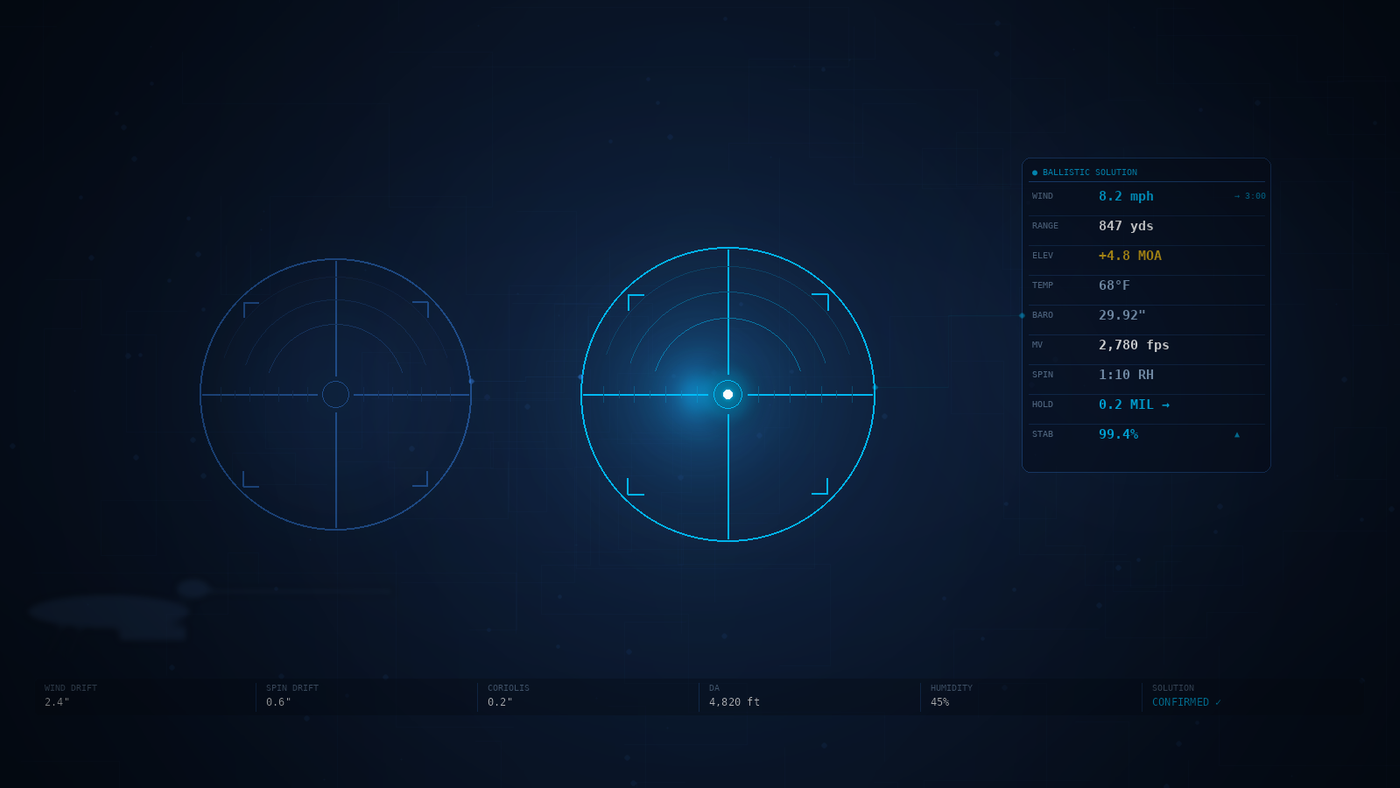
A ballistic solver in the hands of a shooter who understands external ballistics, has verified their zero, knows their load's true velocity, and has built the wind-reading intuition that no device can fully replace — that solver is a genuine force multiplier. It compresses the time to a correct solution and handles the atmospheric math that would take minutes to run manually. It makes a capable shooter faster and more precise.
The same solver in the hands of a shooter who hasn't done the foundational work produces a shooter who can appear capable under ideal conditions and falls apart when the device fails, the battery dies, or the conditions fall outside the solver's assumptions. The technology masked the gaps rather than filling them.
This pattern repeats across every category. Thermal imaging finds targets in darkness — it does not teach you to read terrain, understand animal behavior, or make the shot. Electronic hearing protection with ambient amplification enhances your awareness of the environment — it does not replace the patience and stillness that experienced hunters develop over years. Red dot optics speed target acquisition — they do not build the trigger discipline that produces clean breaks under stress.
Where Training Technology Changes the Equation
The most defensible case for technology as genuine capability multiplier is in training. Traditional shooting instruction is largely feel-based and feedback-dependent — a coach watching your form, your own sense of whether the shot broke clean. That feedback is valuable but slow and inconsistent.
Modern training systems have extended this into dimensions that were previously invisible. The ability to turn subjective feel into objective, repeatable data — and track it across sessions — is genuinely new. Tools that measure what's happening during the shot, before the bullet leaves the barrel, give a shooter diagnostic information that wasn't available at any price a decade ago. This space is evolving quickly, and what's coming will make current tools look primitive.
The same logic applies to long-range shooting. A ballistic solver used to understand why holds are correct builds intuition you can apply without the device. A solver used as a black box builds nothing.
Where This Goes
The trajectory points toward tools that are increasingly capable and increasingly integrated: optics with onboard environmental sensors, training systems using computer vision to analyze technique in real time, hearing protection that enhances situational awareness while blocking impulse noise. The line between tool and interface is blurring.
The question that follows each development is the same one it's always been: does this make the shooter more capable, or does it make a less capable shooter appear more capable? The answer depends entirely on how the tool is used.
The Bottom Line
The shooters worth paying attention to run the best tools available, understand what those tools do and don't do, have built the underlying skills so the technology is multiplying something real — and can set it all down and still perform.
The technology is the easier half of that equation. But used right, it's a genuine edge.