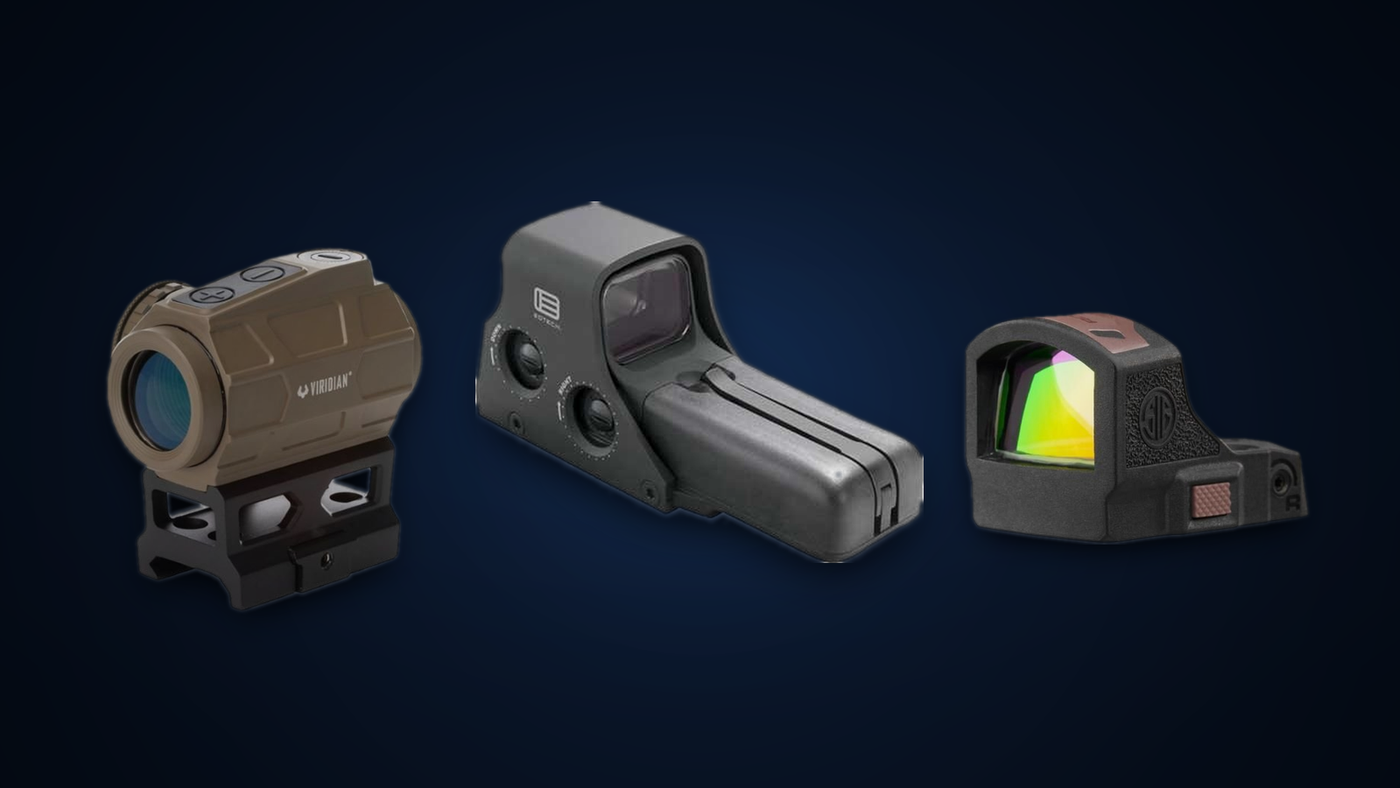
Red Dot Sights vs. Holographic Sights: Technology, Performance, and When to Choose Which
Red dot sights and holographic sights both accomplish the same basic goal — put an illuminated aiming point in front of your eye without magnification, allowing fast target acquisition with both eyes open. But they do it with fundamentally different technology, and that difference drives meaningful tradeoffs in battery life, reticle design, size, cost, and specific use cases. Here's a straight comparison of both.
How they actually work
Red dot sights
A red dot sight uses an LED emitter to project a dot onto a curved, coated lens. The coating reflects only the wavelength of light the LED produces (typically red or green) back toward the shooter's eye, while remaining transparent to the scene downrange. The result is an illuminated dot that appears superimposed on the target.
The technology is simple, efficient, and robust. The LED draws minimal power, which is the primary reason red dot battery life is measured in tens of thousands of hours. The lens, reflective coating, and LED are the core components — there's relatively little that can fail.
Red dot sights come in two main form factors:
Tube-style (reflex) — an enclosed tube housing with the LED at the rear. More rugged, better weather sealing, longer battery life in some designs. Aimpoint is the dominant example.
Open reflex — a small emitter housing with an open or minimally enclosed lens. More compact, lower profile, popular for pistols and lightweight rifle builds. Trijicon RMR, Holosun 507C, and similar optics are in this category.
Holographic sights
A holographic sight uses a laser diode — not an LED — to illuminate a reticle pattern that has been recorded as a hologram on the optic's lens. The laser reconstructs the holographic image, which appears to float in space at a specific focal distance ahead of the optic. The reticle is not a dot projected onto glass — it's a reconstructed three-dimensional holographic image.
This is a substantially more complex system than an LED red dot. The laser diode, optical pathway, mirrors, and holographic film all contribute to a more power-hungry and mechanically complex device. It also produces a reticle with characteristics that differ meaningfully from an LED dot, which matters for specific shooters and situations.
Important clarification: True holographic weapon sights are currently made by only two manufacturers — EOTech and Vortex (the Razor AMG UH-1). Many red dot sights use circle-and-dot reticles that look similar to EOTech's iconic 68 MOA ring, but if it's not from EOTech or Vortex's holographic line, it is an LED-based reflex sight, not a true holographic. The distinction matters technically even if both can be effective tools.
Battery life: the biggest practical difference
This is where the two technologies diverge most dramatically, and it's a difference that has real operational consequences.
Red dot sights often exceed 50,000 hours of battery life, while holographic sights typically run 500–1,000 hours. To put that in perspective: a red dot running 50,000 hours at 12 hours per day would last over 11 years on a single battery. A holographic sight at 600 hours is roughly 25 days of continuous use.
For a home defense firearm that needs to be always-on and always ready, this gap is operationally significant. A red dot can be left on continuously and largely forgotten about from a battery management standpoint. A holographic sight in always-on mode requires regular battery checks and changes.
For range use and training where the optic is turned on for sessions and off between them, the gap narrows considerably in practical terms. 600–1,000 hours of active use is still a lot of range sessions. But for duty, carry, or home defense applications, battery life is a legitimate factor in the decision.
Features: shake-awake, auto-off, and NV compatibility
Shake-awake (motion activation)
Shake-awake is a motion-sensor feature that puts the optic into a low-power sleep state when motionless and wakes it instantly when the firearm is moved. It extends battery life dramatically for optics on firearms that aren't in constant use — a home defense pistol sitting in a safe, a hunting rifle in a case — while ensuring the optic is active the moment you pick up the gun.
Shake-awake has been a standard feature on red dot sights across most of the market for several years, appearing in everything from budget Holosun units to premium Aimpoints. It's one of the key reasons red dot battery life is so operationally forgiving — the battery isn't draining when the gun isn't moving.
Holographic sights have historically lacked shake-awake, relying instead on auto-off timers. The EOTech EXPS3 HD, introduced recently, added shake-awake to the holographic category — a notable development that addresses one of the traditional battery life complaints. However, it remains the exception rather than the rule for holographic sights.
Auto-off timers
Most EOTech holographic sights use programmable auto-off timers — the optic shuts itself off after 4 or 8 hours from the last button press, depending on which button is used to activate it. This prevents accidental battery drain from leaving the optic on but doesn't provide the instant-on, motion-activated convenience of shake-awake.
Night vision compatibility
Many quality red dot sights and holographic sights offer night-vision-compatible brightness settings — very low output modes designed to work with NVDs without blooming. On the EOTech line, the EXPS3 (vs. the EXPS2) is specifically distinguished by its dedicated NV settings. For shooters running NV, verifying NV-compatible modes on any optic is an important spec to check.
Reticle design and what it means in use
Red dot reticles
The standard red dot reticle is exactly what the name implies — a dot. Dot size is measured in MOA (minutes of angle): 1 MOA covers 1 inch at 100 yards, 2 MOA covers 2 inches, etc.
- Small dots (1–2 MOA) — more precise at distance, finer aiming point, but harder to find quickly under stress
- Large dots (4–8 MOA) — faster acquisition under stress, more forgiving, but covers more of the target at distance
- Circle-dot reticles — an inner dot for precision surrounded by a larger circle for fast close-range acquisition, available on many red dot sights (not exclusive to holographic)
Holographic reticles
The iconic EOTech reticle is a 68 MOA outer ring with a 1 MOA center dot. The large ring serves as a fast close-quarters aiming reference — at CQB distances a human-sized target fits naturally inside the ring, making the aiming gesture extremely fast and intuitive. The center dot provides precision for longer shots. Additional inner dots on some models serve as holdover references for common distances.
The holographic reticle has a specific characteristic worth knowing: it has a slight grain or texture when viewed close up, which is a product of the holographic reconstruction process. This is normal and not a defect. At typical shooting distances, looking through the optic at the target rather than focusing on the reticle itself produces the clearest image.
Reticles and astigmatism
This is one of the most practically important distinctions between the two technologies and one that's easy to overlook in product comparisons.
Astigmatism — an irregularity in the curvature of the cornea — affects a significant portion of the shooting population. For astigmatic eyes, LED-based red dots often appear not as a clean dot but as a starburst, smear, or comet-tail shape. This can make precise aiming genuinely difficult and can be significant enough that red dot use is frustrating or impractical without corrective lenses.
Holographic sights produce a reticle through a fundamentally different mechanism — laser reconstruction of a holographic image rather than LED reflection — and many astigmatic shooters find the holographic reticle appears significantly cleaner and more defined than an LED dot. This is not universal (some astigmatic shooters still see smearing through holographic optics), but it is a consistent enough pattern that if you have astigmatism and red dots are problematic for you, a holographic sight is worth trying before ruling out unmagnified optics entirely.
Parallax
Both red dot sights and holographic sights are designed to be parallax-free or nearly so — meaning the reticle stays on the point of aim regardless of where your eye is positioned behind the optic, within reasonable limits.
The technical reality is more nuanced. True parallax-free performance exists only at a specific distance for any optic. Modern quality red dots have extremely minimal parallax at typical engagement distances. Holographic sights, due to the nature of how the reticle is projected, tend to handle off-axis eye position and extreme viewing angles somewhat better — a meaningful advantage in dynamic shooting positions, shooting around cover, or awkward positions where a consistent cheek weld isn't possible.
For most shooters at typical engagement distances, the parallax difference is not meaningful in practice. For competitive shooters engaging targets from unconventional positions, or for anyone shooting regularly from behind cover, the holographic's parallax advantage is a real consideration.
Durability and a unique holographic advantage
Both technologies can be built to extremely high durability standards, and quality examples of both will handle significant abuse. But there's one specific durability characteristic of holographic sights that has no equivalent in red dot design:
A holographic sight can continue to function with a cracked or partially obstructed front lens. Because the reticle is recorded in the holographic film on the lens rather than projected through the glass, any portion of the lens that remains intact can still reconstruct the reticle. A shattered front lens on a red dot destroys the reflective surface and eliminates the dot. On a holographic sight, the same damage may still produce a usable aiming point.
In a worst-case field scenario where an optic takes a hard strike that damages the glass, this is a meaningful operational advantage. It doesn't make holographic sights bulletproof, but it is a genuine capability difference worth knowing.
Size, weight, and platform compatibility
Rifle and carbine use
Both technologies work well on rifles. Red dot tube sights (Aimpoint style) run roughly 3–5 inches long and 3–5 oz. Open reflex red dots are smaller and lighter. EOTech holographic sights run approximately 3.5–4 inches long and 9–12 oz — noticeably heavier than most red dots, though not prohibitively so on a full-size rifle platform.
The larger window of holographic sights — a wider viewing area than most red dot designs — is a genuine advantage for fast CQB target acquisition and for maintaining peripheral awareness while shooting. Many shooters find the large EOTech window faster and more forgiving to acquire under stress than a smaller red dot tube.
For shotguns, both work well. The fast-acquisition characteristics of either unmagnified optic suit the close-range, quick-target role shotguns typically fill.
Pistol use
This is where the platform question has a clear answer: holographic sights are not practical for pistols in their current form. No micro holographic sights exist for slide-mounting. The smallest EOTech holographic sights are too large and heavy for practical handgun carry or concealed carry use.
Pistol-mounted optics are almost exclusively red dot sights — specifically the open reflex category using standardized mounting footprints (RMR cut, Shield RMSc cut, and similar). Trijicon RMR, Holosun 507C/407C, SIG Romeo Zero, and similar micro red dots are purpose-built for pistol slides and dominate this category. Shake-awake is particularly valuable on pistol-mounted optics, ensuring the optic is active from the first movement of a draw stroke.
Pricing
Red dot sights span the widest price range of any optic category — from sub-$100 budget units to $800–1,000 premium Aimpoints. Quality mid-tier options (Holosun, Primary Arms ACSS, SIG Romeo series) provide solid performance in the $150–400 range. Premium tube red dots from Aimpoint ($600–900) represent the top of the category.
Holographic sights occupy a narrower and higher price band. Entry EOTech models start around $500–600. The EXPS3 runs approximately $749. The EXPS3 HD with shake-awake is approximately $999. The Vortex Razor AMG UH-1 Gen II sits in a similar range. There are no budget holographic sight options — the technology doesn't lend itself to significant cost reduction.
The price premium for holographic is real and consistent. For a shooter who values the specific advantages of holographic technology — reticle design, astigmatism performance, large window, durability under lens damage — the premium is justifiable. For a shooter prioritizing battery life, lighter weight, and value, the red dot category offers equivalent or superior options at lower cost.
Magnifier compatibility
Both red dot and holographic sights work with clip-on magnifiers (3x, 5x, 6x) that mount behind the optic on a flip-to-side mount. This combination provides a versatile near/far capability — unobstructed at 1x for CQB, magnifier deployed for distance work.
Holographic sights actually have a specific advantage with magnifiers: because the reticle is a holographic image rather than an LED dot, it scales cleanly with magnification — the 68 MOA ring and 1 MOA dot maintain their relative proportions. The 1 MOA center dot remains a 1 MOA dot at 3x — still covering 1 inch at 100 yards. This predictability is useful for shooters who use the magnifier regularly.
Which one for which application
Home defense carbine or shotgun: Either works well. Red dot's battery life advantage and shake-awake make it more operationally simple. Holographic's large window and fast reticle design are genuine advantages in CQB scenarios. Personal preference and astigmatism status often drive this decision.
Competition and training: Red dot is the dominant choice for most competition formats due to weight, battery life, and the wide range of options available. Holographic suits competitors who prioritize the large window for fast acquisition.
Hunting: Red dot wins on battery life and weight for most hunting applications. A red dot left in a rifle case for months between seasons doesn't require battery management the way a holographic does.
Pistol: Red dot only — no practical holographic option exists for handguns.
Shooters with astigmatism: Try a holographic before ruling out unmagnified optics. The reticle characteristics may be significantly better for your eyes.
NV-paired setups: Both are available with NV-compatible modes. Verify the specific model has dedicated NV brightness settings rather than just low-end settings that aren't calibrated for NVDs.
Red dot and holographic sights each have real strengths and the right choice depends on platform, use case, and the shooter. HildiTech carries options across both categories — if you want to work through which makes sense for your setup, we're set up to help.