Kestrel Weather Meters for Shooters: What They Measure and Why It Matters
If you shoot long range, you've probably heard someone mention a Kestrel. If you're new to the space, you might be wondering why a weather meter has become standard kit for serious precision shooters and long range hunters. The answer is straightforward: at distance, environmental conditions determine where your bullet hits. A Kestrel measures those conditions accurately, at your exact location, at the moment you shoot. Here's what they actually do, who needs one, and how to choose the right model.
Why environment matters at distance
At short range — 100 to 200 yards — atmospheric conditions have a minor effect on bullet impact. Most shooters zero their rifles and don't think much about it beyond that. As range extends, that changes dramatically.
Several environmental variables influence bullet trajectory in ways that become significant past 400–500 yards:
Wind is the dominant variable. A 10 mph full-value crosswind moves a typical .308 bullet roughly 8 inches at 500 yards and nearly 35 inches at 1,000 yards. Even a 5 mph wind that's hard to perceive with your skin is a significant factor at distance. Misreading wind — its speed, its direction, and whether it's consistent across the full range to the target — is the primary cause of long range misses.
Air density affects how much drag the bullet experiences throughout its flight. Denser air slows the bullet more, increasing drop. Air density is a function of three variables: temperature, humidity, and barometric pressure. A cold, humid, high-pressure day produces denser air than a hot, dry, high-altitude day — and those differences are measurable and predictable. At 600 yards, the difference between sea-level shooting on a cold morning and high-elevation shooting on a warm afternoon can shift your point of impact by several inches with the same load and zero.
Altitude and density altitude matter because as elevation increases, air becomes thinner. A load zeroed at sea level will impact noticeably higher at 5,000 feet elevation — the bullet experiences less drag and shoots flatter. Hunters who travel from lower elevations to hunt in mountain terrain need to account for this. Density altitude combines the effects of elevation, temperature, and humidity into a single value that accurately represents the true aerodynamic environment the bullet is flying through.
The job of a Kestrel is to measure all of these variables accurately, at your location, right now — not at the nearest weather station 20 miles away, not based on a forecast, but the actual conditions at the moment of the shot.
What a Kestrel actually measures
Every Kestrel weather meter, regardless of model, shares a core set of sensors:
Wind speed — measured through an impeller (the spinning cup on the back of the unit). This is the most-used function for most shooters. Kestrel's impeller is accurate down to very low wind speeds and responds quickly to gusts and lulls, which matters when you're trying to time a shot in variable wind.
Temperature — measured via a sensor on the unit. Accurate temperature is needed to calculate air density correctly.
Relative humidity — measured by a dedicated humidity sensor. Humidity contributes to air density calculations, though it's a smaller factor than temperature and pressure.
Barometric pressure / station pressure — this is important to get right. Most weather apps and stations report sea-level-corrected barometric pressure, which adjusts the raw pressure reading to what it would be at sea level. For ballistics, you want station pressure — the actual atmospheric pressure at your elevation. Kestrel measures and displays station pressure directly, which is what a ballistic solver needs for accurate air density calculations.
Density altitude — calculated from the above measurements. Combines temperature, humidity, and station pressure into a single value representing the aerodynamic environment. This is the number you're most likely to feed into a ballistic solver or manually reference.
Higher-end models add:
Compass direction — for determining wind angle relative to the direction of fire (crosswind vs. headwind/tailwind), which affects how much wind correction to apply.
Wind direction — with the vane mount accessory, the unit can be set up to log wind direction relative to the target, giving the shooter a more complete picture of what's happening downrange.
The Kestrel lineup — what the models actually mean
Kestrel makes an array of models that can be confusing to navigate. Here's the practical breakdown for shooters:
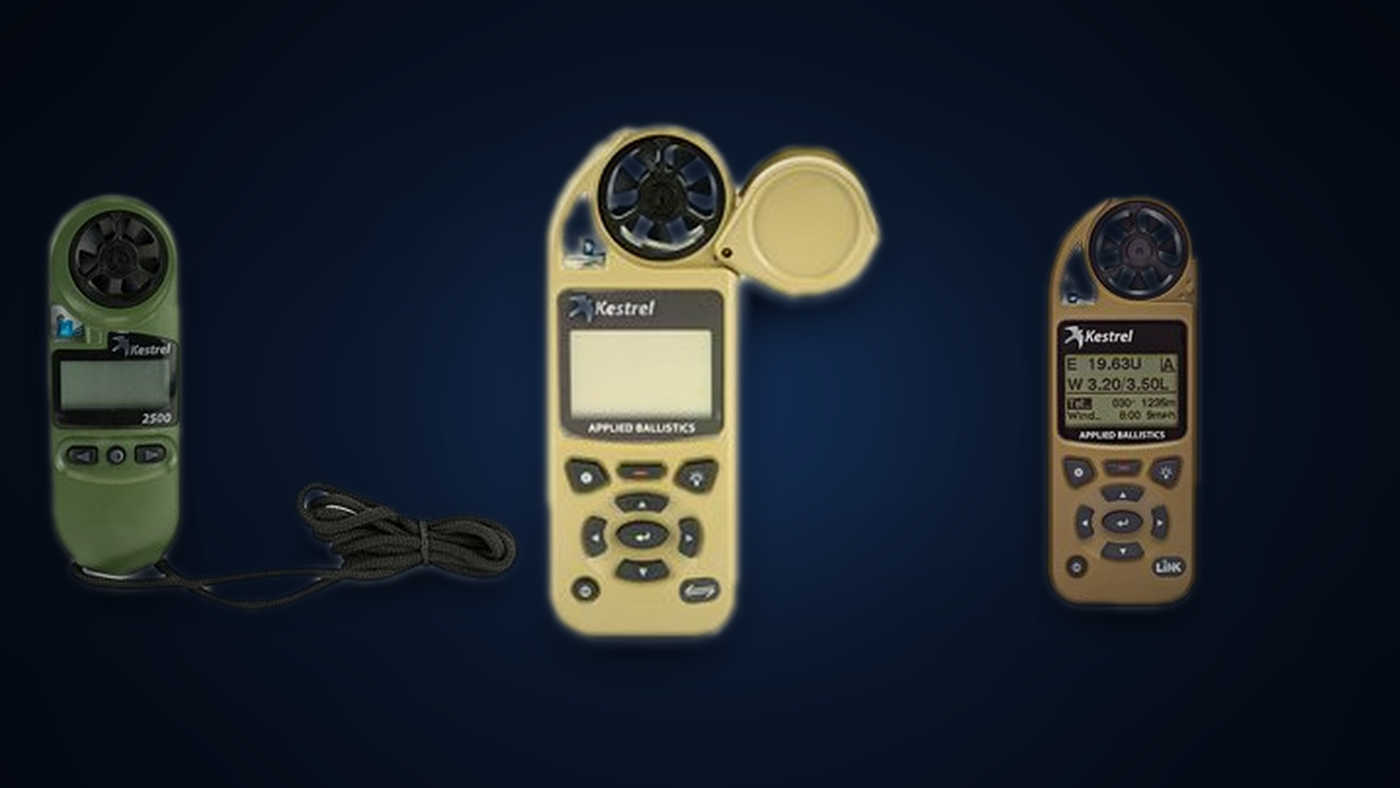
Entry level — DROP D3 and Kestrel 2500 (~$100–200)
The DROP D3 is a small, clip-on sensor that pairs with a smartphone app via Bluetooth. It measures temperature, humidity, and pressure — enough to calculate density altitude — but does not have an impeller for wind measurement. For a shooter who already has a way to read wind (flags, mirage, experience) and just needs accurate atmospherics to feed into a phone-based ballistic app, this is a functional and affordable solution.
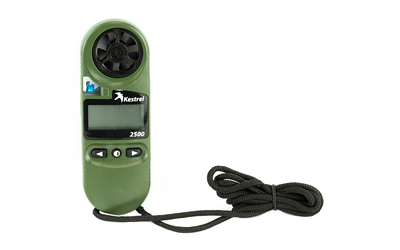
The Kestrel 2500 adds an impeller for wind speed and can be used as a standalone device without a phone. It doesn't have a ballistic solver built in, but it gives you the numbers you need to enter manually into a ballistic app. Practical for hunters and shooters who want accurate field data without a significant investment.
Mid-tier ballistics — Kestrel 2700 (~$200–250)
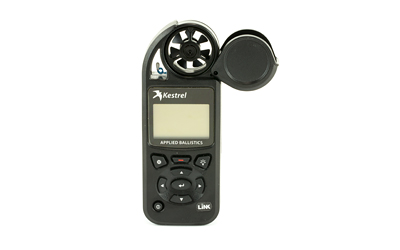
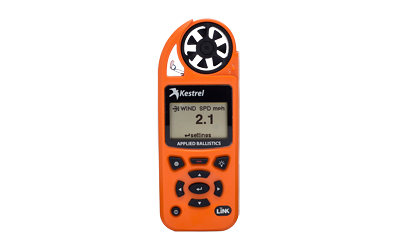
The 2700 is where the lineup gets interesting for hunters specifically. It combines the environmental measurements of the weather-only models with a built-in ballistics calculator — G1 and G7 drag models — and Bluetooth LiNK connectivity. You load your rifle and bullet profile via the free Kestrel LiNK app, and the unit calculates elevation and windage corrections for your specific load based on the measured conditions.
For hunters taking shots inside 600–800 yards in varying terrain and conditions — mountain elk, western mule deer, open country antelope — the 2700 is a practical and capable tool. The ballistics engine is simpler than the upper-tier models, but for typical hunting distances it delivers reliable solutions without the complexity or cost of the flagship units.
The serious long range tier — Kestrel 5700 (~$400)
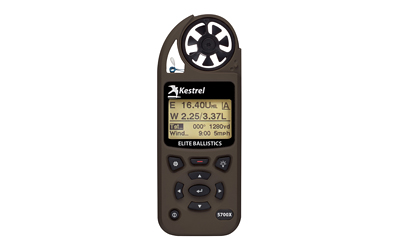
The 5700 uses the same physical chassis as the Elite — same sensors, same build quality, same waterproofing and drop resistance — but runs a different ballistics software package. It uses G1 and G7 drag models and is capable for shots inside roughly 1,200 yards. It connects via LiNK, supports multiple gun profiles, and represents a significant step up in capability over the 2700.
The 5700 is a legitimate choice for long range shooters whose primary use is inside 1,000 yards and who don't need the advanced features of the Elite. It can also be upgraded to Elite software later by sending the unit back to Kestrel, which matters if you want to start here and step up as your shooting progresses.
One important limitation: the 5700 does not include Drop Scale Factor (DSF). DSF is a correction that accounts for real-world bullet behavior that deviates from the theoretical drag model, particularly as the bullet approaches and passes through the transonic zone (roughly 1,200–1,500 yards depending on the cartridge and conditions). If your shooting regularly pushes into or past transonic, DSF matters and you should get the Elite.
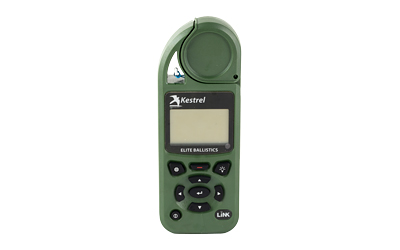
The flagship — Kestrel 5700 Elite with Applied Ballistics (~$700)
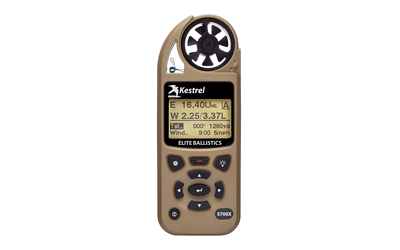
The 5700 Elite shares the exact same hardware as the standard 5700. The difference is entirely in the software: the Elite runs Applied Ballistics, the ballistics engine developed by Bryan Litz that has become the industry standard for precision long range shooting.
What the Applied Ballistics engine brings that the standard 5700 doesn't:
Custom Drag Models (CDMs) — rather than relying on a G1 or G7 approximation of bullet drag, the Elite has access to Applied Ballistics' measured drag curves for hundreds of specific bullets. A CDM is a measured drag profile for that exact bullet, not a theoretical approximation. At extreme range this difference matters — G1/G7 models are the bullet manufacturer's approximation; CDMs are what Bryan Litz's team actually measured.
Drop Scale Factor (DSF) — allows you to apply a correction factor based on real-world observed drop with your specific rifle and load, adjusting the solver output to match actual performance. Critical for shooting in and past transonic.
Coriolis and spin drift corrections — at extreme long range (1,000+ yards), the Earth's rotation causes a small but measurable deflection of the bullet (Coriolis effect), and the bullet's spin causes a predictable lateral drift (spin drift). The Elite accounts for both. At hunting distances these are minor. At ELR distances they're significant.
Aerodynamic jump correction — accounts for bullet deflection caused by crosswind at the muzzle. Relevant at extreme range and high wind.
For PRS competitors, ELR shooters, and hunters who regularly take shots past 800–1,000 yards in variable conditions, the Elite's additional capabilities are the right tools. For most hunting applications inside 600–700 yards, the 2700 or 5700 is likely sufficient.
The 5700X — for ELR and multi-target shooting
The 5700X adds processing power for faster firing solutions at extreme long range and supports WEZ (Weaponized Error Zone) analysis — a probabilistic tool that shows the shooter how much various error sources contribute to dispersion at distance. Relevant for ELR competitors and serious match shooters. Beyond the scope of most hunting applications.
Practical use: hunters vs. long range shooters
For hunters, the Kestrel workflow is typically simpler. You're making one shot, usually on a known or rangefinder-confirmed distance, in conditions you've had time to read. The primary value is accurate density altitude for drop correction and wind speed for wind holds. A 2700 or 5700 covers most hunting scenarios well. The Elite is worth it if you're a serious Western hunter taking shots past 500 yards regularly in variable mountain conditions where accurate solutions give you confidence in the shot.
One practical tip for hunters: use the Kestrel to measure conditions at your position, but think about what the wind is doing across the full range to the target. Wind often varies — a calm position in timber can have very different conditions in an open meadow where the bullet travels. Reading mirage and vegetation movement downrange matters alongside what the Kestrel tells you at your position.
For long range and precision shooters, the Kestrel becomes a more integral part of the firing solution. At 800+ yards, accurate atmospheric data is not optional — it's the difference between first-round hits and data collection. The 5700 Elite paired with a quality rangefinder covers the workflow well for most applications. The LiNK Bluetooth connection means you can adjust range and direction of fire from your phone app and read the updated solution without handling the meter between shots.
At PRS-level competition where you're shooting multiple stages in changing conditions with limited time per target, the Kestrel's ability to deliver a rapid updated solution as temperature and pressure change through the day is a meaningful advantage over manually updating a phone-based solver.
Do you need dedicated hardware, or will a phone app do?
This is a legitimate question worth addressing honestly. A Kestrel 5700 Elite is roughly $700. A quality phone-based ballistic app like BallistX, Applied Ballistics Mobile, or Hornady 4DOF is $30–100 per year. If you pair a basic Kestrel 2500 (~$150) with a quality phone app, you get accurate on-site atmospheric data fed into a capable solver for under $300 total.
For most hunters and many long range shooters, that combination is entirely adequate. The advantage of the dedicated Kestrel ballistics units is field reliability — a waterproof, purpose-built device with physical buttons works in driving rain and with gloves on when a touchscreen phone doesn't. At PRS matches and in demanding field conditions, that reliability has real value. For range shooting in reasonable conditions, a phone app with accurate atmospheric inputs performs comparably.
The honest answer: if you're primarily a range shooter or occasional long range hunter, start with a weather-only Kestrel and a phone-based solver. If you're competing seriously, hunting hard in demanding terrain regularly, or shooting consistently past 800 yards in variable conditions — the dedicated ballistics unit earns its cost.
Kestrel meters are a direct complement to the rangefinders, optics, and ballistic tools in HildiTech's lineup. The second article in this series covers Applied Ballistics integration in more depth — pairing your Kestrel with a solver and building a complete firing solution.