Electronic Hearing Protection: Why Serious Shooters and Hunters Don't Settle for Passive
Hearing loss from gunfire is permanent and cumulative. Unlike many shooting-related injuries, it happens silently and gradually — most shooters don't notice the damage until years later when they realize they're asking people to repeat themselves constantly or they can't sleep through the ringing. The good news is it's entirely preventable. The question isn't whether to wear hearing protection — it's whether you want protection that also makes you a more capable shooter and hunter, or protection that simply plugs you off from the world.
Why gunfire is uniquely damaging to hearing
Sound is measured in decibels (dB), a logarithmic scale — meaning each increase of 10 dB represents roughly 10 times the sound energy, not just a proportional increase. Normal conversation sits around 60 dB. A lawnmower is around 90 dB. The threshold where a single impulse can cause immediate, permanent hearing damage is generally accepted at 140 dB.
Gunfire typically starts at 140 dB and goes up from there. A 9mm pistol produces around 160 dB at the muzzle. A 5.56 rifle runs around 165 dB. A .308 or 12-gauge can reach 170 dB or higher. Muzzle brakes — common on precision rifles to manage recoil — can push those numbers even higher, and redirect the blast laterally toward adjacent shooters.
Gunfire is also an impulse noise rather than continuous noise, which makes it particularly damaging. The pressure wave arrives instantly, faster than the ear's natural protective reflex (the acoustic reflex) can engage. You cannot train yourself to not be damaged by unprotected gunfire — the physics don't allow it.
One unprotected shot in a close-range environment can cause measurable permanent damage. Cumulative exposure without adequate protection compounds that damage every session.
The baseline: what passive protection does and doesn't do
Passive protection — foam earplugs and non-electronic earmuffs — is the traditional answer to gunfire noise. It works on a simple principle: put enough acoustic barrier material between the sound and your eardrum to reduce the level below the damage threshold.
Quality foam earplugs deliver 29–33 dB of noise reduction when properly inserted. Passive earmuffs typically rate 22–31 dB NRR. Either handles the job of protecting your hearing from the shot itself.
What passive protection cannot do is discriminate. It attenuates everything equally — the gunshot and the conversation standing next to you, the muzzle blast and the deer walking through dry leaves 80 yards away, the shot and the range officer's commands. In a passive muff or properly seated foam earplug, you are acoustically isolated from your environment. Protected, yes. Aware, no.
For the casual solo range session where you're just putting rounds downrange with no one to talk to and nothing to listen for, passive protection is technically sufficient. But that describes a narrow slice of how serious shooters and hunters actually operate. The moment you add an instructor, a shooting partner, a training course, a hunting scenario, or any situation where situational awareness matters — passive protection becomes a liability as much as a tool.
This is the problem electronic hearing protection solves.
How electronic hearing protection works
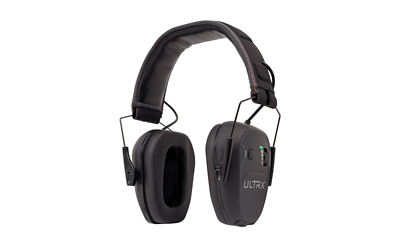
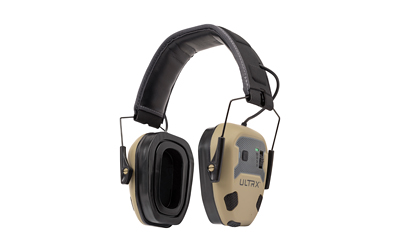
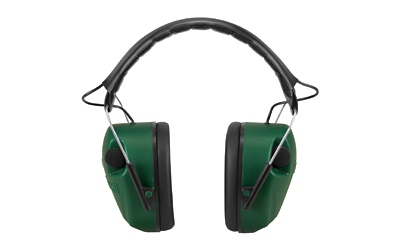
Electronic earmuffs share the same fundamental architecture as passive muffs — a sealed cup with acoustic attenuation material that provides a physical sound barrier. What's added is a microphone on the outside of the cup, an amplifier circuit, and a speaker on the inside.
Ambient sounds are picked up by the external microphone, processed by the electronics, and played back through the internal speaker at safe levels. Normal ambient sounds — conversation, range commands, environmental noise, game movement — pass through at natural or even amplified levels. When the microphone detects a sound above a set threshold — typically around 82–85 dB, well below a gunshot — the circuit suppresses the signal, and the ear is protected by the passive attenuation of the cup itself.
The result: you hear everything you want to hear, and the shot is blocked before it reaches your ear. The transition happens in milliseconds — fast enough that the shot is effectively suppressed while normal conversation flows without interruption.
Attack time and release time
The two performance specs that separate quality electronic muffs from budget units are attack time and release time.
Attack time is how fast the circuit suppresses the loud sound. This needs to be nearly instantaneous — any lag means a portion of the impulse reaches the speaker before suppression engages. Quality units measure attack time in microseconds.
Release time is how fast the unit recovers normal amplification after the shot. Budget units can have a noticeable dead period — a half second or more of reduced audio after each shot — where the circuit is still recovering. In a training environment with rapid strings of fire, or in a hunting scenario where you need to immediately process what's happening after a shot, slow release time is a real functional limitation. Premium units recover fast enough that the audio experience is nearly seamless.
Compression vs. hard cutoff
There are two approaches to how the circuit handles loud sounds:
Hard cutoff — the circuit shuts off entirely above the threshold. Complete protection, but total audio loss during the event. Common in entry-level electronic muffs.
Dynamic compression — the circuit rapidly attenuates the signal rather than cutting it off. This preserves some ambient audio even during loud events and recovers faster. Higher-end units use this approach and produce a significantly more natural listening experience, particularly in multi-shot scenarios.
Ambient amplification — the capability that changes the game
Beyond simply passing ambient sound through safely, most electronic muffs amplify sounds below the threshold — typically to a maximum of around 82 dB. This means you can hear your environment better through the muffs than you can with nothing on your ears at all.
For hunters, this is the capability that transforms hearing protection from a reluctant safety measure into an active hunting tool. Game movement — a deer's footfall in dry leaves, the snap of a branch, the soft footsteps of a predator working toward a call — is often subtle. Electronic muffs with quality ambient amplification pick up these sounds and deliver them clearly, while simultaneously protecting your hearing when the shot comes. Many hunters who previously went without protection now use electronic muffs specifically because they hear better with them than without.
Directional audio
Quality electronic hunting and tactical muffs use separate microphones on each side of the head feeding separate speakers, preserving stereo imaging. This means you retain the ability to localize sound — to tell which direction a sound is coming from. For hunters trying to pinpoint the location of game, and for shooters in dynamic training environments where awareness of what's happening around you matters, directional capability is a genuine operational advantage.
Budget units often use a single microphone with mono playback. You hear the amplified ambient sound but lose the spatial information that tells you where it's coming from. This is a meaningful difference in field use that's easy to overlook on a spec sheet.
Protection levels by weapon type and environment
Electronic muffs span a wide NRR range. Matching the protection level to the application matters.
Handguns (9mm, .45 ACP, .357 Mag) Typical range: 155–165 dB unsuppressed. Quality electronic muffs with NRR 22+ provide adequate protection for standard pistol calibers at outdoor ranges. At indoor ranges, the enclosed environment reflects and compounds the sound — dual protection (electronic muffs over foam plugs) is strongly recommended regardless of caliber indoors.
.22 LR rimfire Still loud enough to damage hearing — typically 140–155 dB. Often underestimated because it sounds "small." Standard electronic muffs are entirely adequate.
Standard centerfire rifles (5.56, .308, 6.5 Creedmoor) 165–170 dB range. Electronic muffs with NRR 25+ handle outdoor rifle shooting well. For indoor rifle ranges, add foam plugs underneath. Prolonged high-round-count centerfire sessions warrant extra attention to protection quality.
Magnum rifles and large bore calibers (.300 Win Mag, .338 Lapua, .50 BMG) 170+ dB. Higher-NRR electronic muffs with foam plugs underneath is the appropriate standard. Muzzle brakes on these platforms redirect the blast laterally — anyone standing adjacent to a muzzle-braked large bore rifle is taking significant acoustic exposure even though they're not the shooter. Electronic muffs protect everyone on the line, not just the shooter.
Shotguns 12-gauge typically runs 160–165 dB. Standard electronic muffs handle it at outdoor ranges; dual protection indoors.
Indoor ranges Add 5–10 dB to any of the above figures. Reflected sound in an enclosed range significantly increases total exposure. Dual protection — electronic muffs over foam plugs — is the right standard for indoor shooting regardless of caliber.
Suppressors and hearing protection: clearing up the misconception
This is worth addressing directly because the misconception is widespread and has real consequences.
Suppressors are not the movie silencers that reduce a gunshot to a whisper. Modern suppressors typically reduce muzzle blast by 25–35 dB. That sounds significant — and it is, in absolute terms — but consider the starting point. A 5.56 rifle at 165 dB reduced by 30 dB is still 135 dB. A suppressed .308 running around 148 dB is still well above the threshold for acoustic trauma from a single shot.
The 140 dB damage threshold means a suppressed centerfire rifle is still in or near damage territory with every shot. The suppressor matters — it genuinely reduces cumulative exposure and makes the shooting environment more tolerable — but it does not eliminate the need for hearing protection with centerfire firearms.
Where suppressors meaningfully change the calculus:
Subsonic .22 LR suppressed is genuinely close to hearing safe — typically 110–120 dB with quality subsonic ammunition. Some shooters choose to forgo hearing protection in this configuration for casual use, though protection remains recommended for extended sessions.
Subsonic pistol calibers suppressed (9mm, .45 ACP with subsonic loads) can reach 120–130 dB suppressed — reduced risk territory, but the sonic crack of a supersonic projectile contributes meaningfully to the report. Subsonic ammunition makes a significant additional difference beyond the suppressor's mechanical reduction.
Suppressor + electronic muffs is an increasingly common and well-matched combination, particularly for hunting. The suppressor brings peak levels down, the electronic muffs provide a safety margin plus full ambient amplification between shots. The result is a setup where you're genuinely hearing-safe, hearing the environment clearly, and not blasting your hunting partner's ears every time you pull the trigger. For hunters in close proximity to guides or partners, this combination is worth serious consideration.
The bottom line on suppressors: they help meaningfully and are a legitimate hearing conservation tool. For centerfire shooting they supplement hearing protection, not replace it.
Electronic muffs in training and instruction
One of the strongest arguments for electronic protection is the training environment — and it's one that passive protection simply cannot match.
Any training scenario involving an instructor means constant communication: corrections, commands, safety calls, target feedback, drill instructions. With passive protection, every exchange between shots requires either removing the muffs, shouting over the attenuation, or just guessing at what was said. None of those are good options in a learning environment, and the last one is a safety issue.
Electronic muffs eliminate this entirely. The instructor speaks at normal volume, you hear it clearly, you respond normally, and when the shot fires the muff handles it automatically. The training session flows continuously without acoustic interruption. For anyone taking instruction seriously — a carbine course, a pistol class, a precision rifle clinic — electronic protection isn't a luxury, it's the appropriate tool for the environment.
The same applies to any competitive shooting format, range sessions with partners, and any situation where you're sharing a range with other people and range commands are part of the safety picture.
What to look for when buying
The electronic hearing protection market ranges from $30 entry-level units to $400+ premium hunting and tactical muffs. The performance differences are real. Key things to evaluate:
NRR rating — should match the firearms you're shooting. 22 dB is the practical minimum for centerfire use; 25–30 dB for rifle calibers and indoor use.
Attack and release time specs — faster is better. Premium units spec attack time in microseconds and recover from shots quickly enough that the audio experience is nearly seamless.
Amplification quality and maximum dB — cheap units amplify everything including background hiss. Quality units produce clean, natural-sounding amplification. Maximum ambient output should be capped at 82 dB or below.
Stereo vs. mono microphones — two microphones for directional awareness vs. one for mono ambient sound. For hunting and tactical use, stereo is not optional.
Compression vs. hard cutoff — dynamic compression for a more natural experience, particularly in multi-shot scenarios.
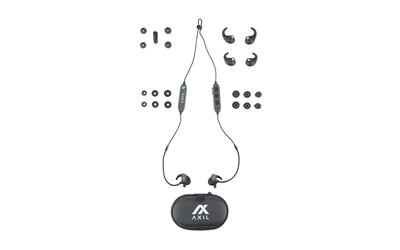
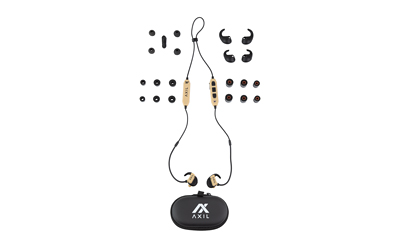
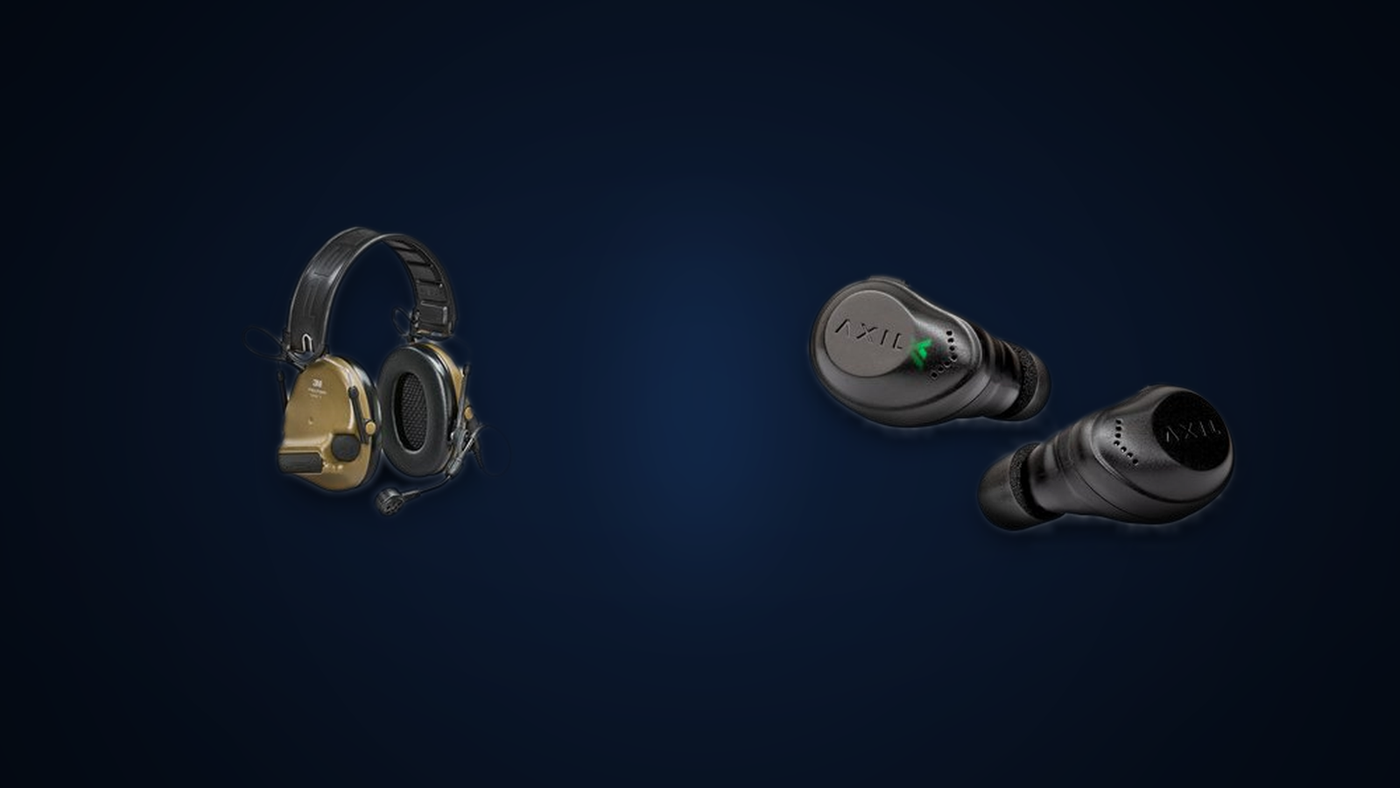
Form factor — over-ear muffs for most range use; low-profile options for use with rifle stocks where a large cup can interfere with cheek weld; in-ear electronic options for users who need lower profile under a hat or helmet.
Electronic hearing protection is one of those purchases where the right tool genuinely changes how you operate — not just how safely. HildiTech carries electronic hearing protection built for serious shooters and hunters, from range-use muffs to premium directional hunting units.